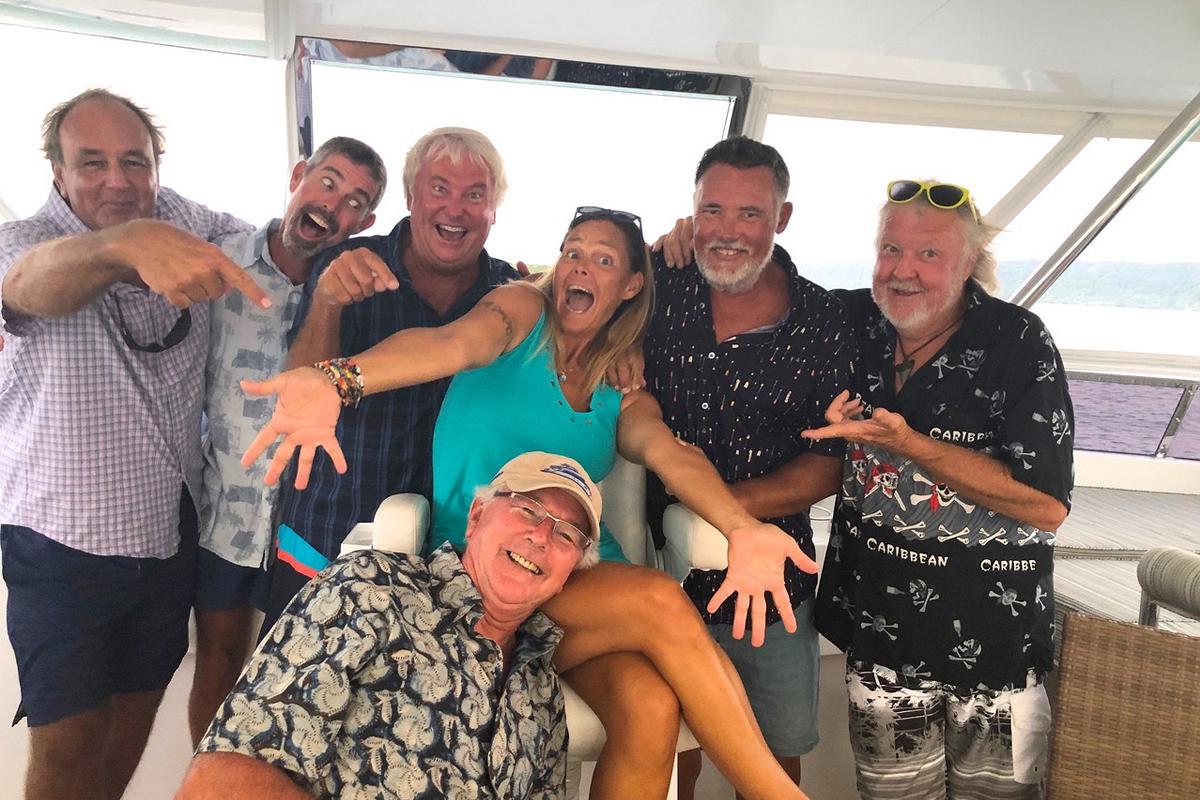
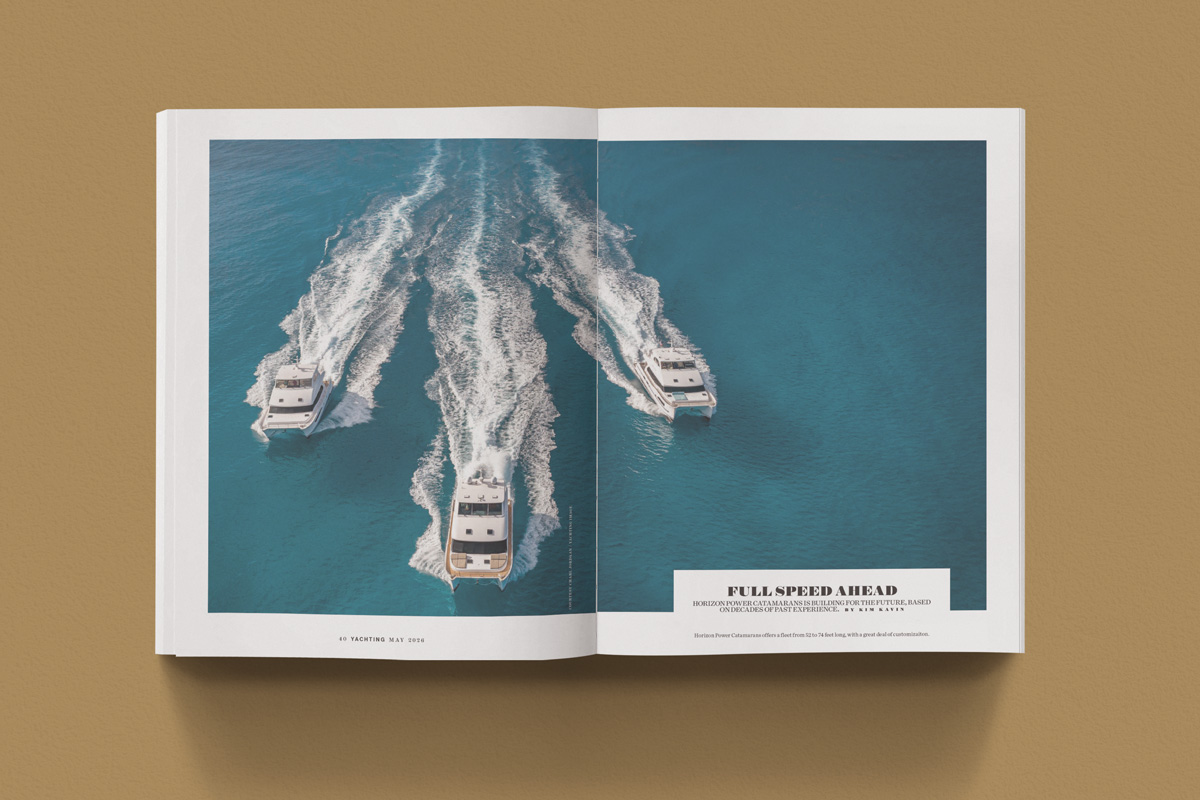
YACHTING MAGAZINE: FULL SPEED AHEAD Horizon Power Catamarans is Building for the Future, Based on Decades of Experience. By Kim Kavin
Yachting Magazine's Kim Kavin dives into the Horizon Power Catamaran story in the May 2026 issue.
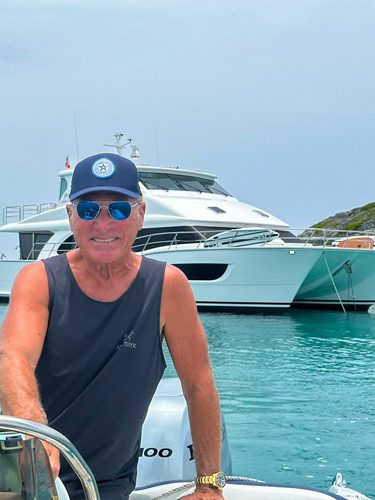
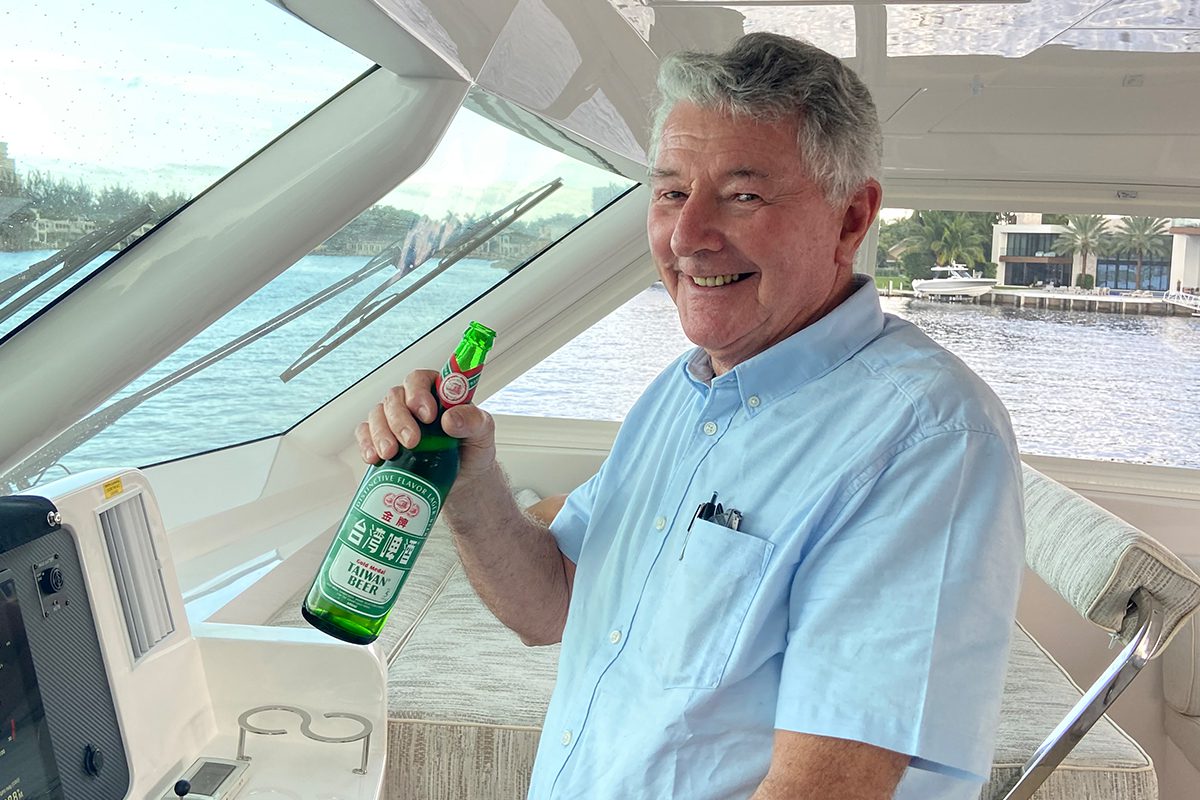
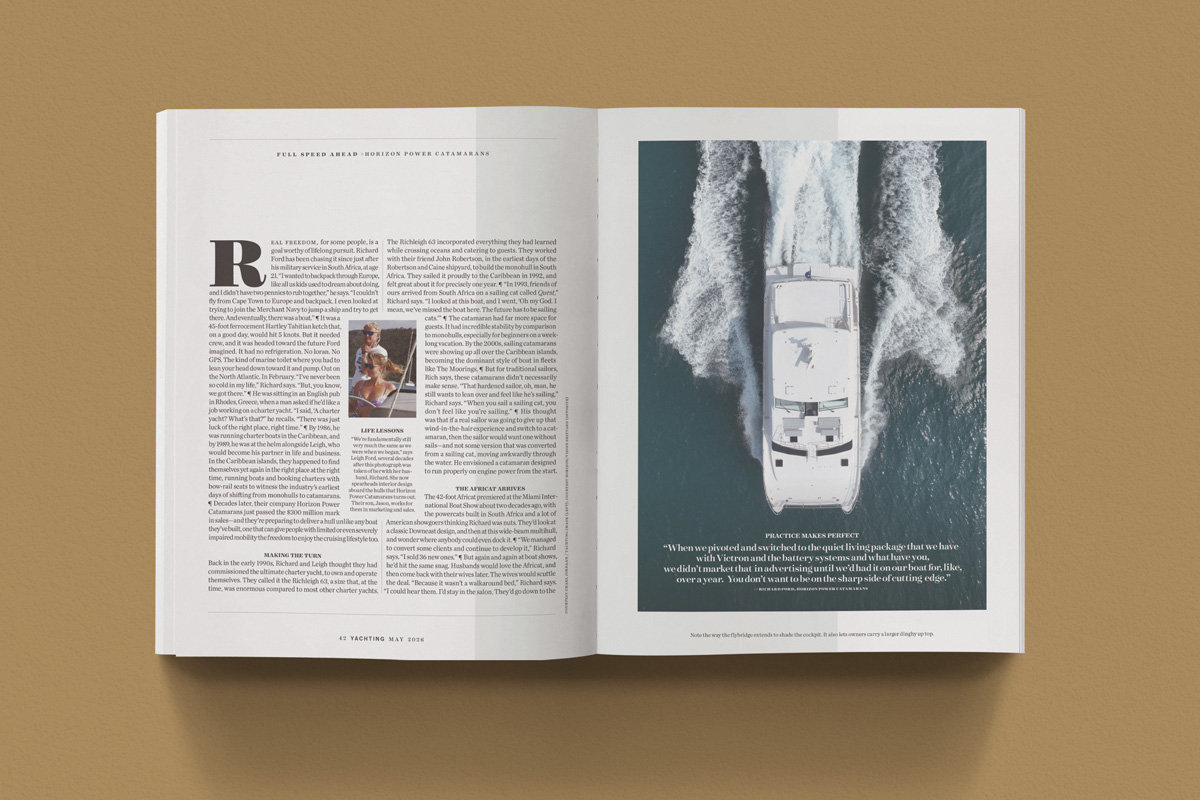
Real freedom, for some people, is a goal worthy of lifelong pursuit. Richard Ford has been chasing it since just after his military service in South Africa, at age 21. “I wanted to backpack through Europe, like all us kids used to dream about doing, and I didn’t have two pennies to rub together,” he says. “I couldn’t fly from Cape Town to Europe and backpack. I even looked at trying to join the Merchant Navy to jump a ship and try to get there. And eventually, there was a boat.”
It was a 45-foot ferrocement Hartley Tahitian ketch that, on a good day, would hit 5 knots. But it needed crew, and it was headed toward the future Ford imagined. It had no refrigeration. No loran. No GPS. The kind of marine toilet where you had to lean your head down toward it and pump. Out on the North Atlantic. In February. “I’ve never been so cold in my life,” Richard says. “But, you know, we got there.”
He was sitting in an English pub in Rhodes, Greece, when a man asked if he’d like a job working on a charter yacht. “I said, ‘A charter yacht? What’s that?” he recalls. “There was just luck of the right place, right time.”
By 1986, he was running charter boats in the Caribbean, and by 1989, he was at the helm alongside Leigh, who would become his partner in life and business. In the Caribbean islands, they happened to find themselves yet again in the right place at the right time, running boats and booking charters with bow-rail seats to witness the industry’s earliest days of shifting from monohulls to catamarans.
Decades later, their company Horizon Power Catamarans just passed the $300 million mark in sales—and they’re preparing to deliver a hull unlike any boat they’ve built, one that can give people with limited or even severely impaired mobility the freedom to enjoy the cruising lifestyle too.
MAKING THE TURN
Back in the early 1990s, Richard and Leigh thought they had commissioned the ultimate charter yacht, to own and operate themselves. They called it the Richleigh 63, a size that, at the time, was enormous compared to most other charter yachts.
The Richleigh 63 incorporated everything they had learned while crossing oceans and catering to guests. They worked with their friend John Robertson, in the earliest days of the Robertson and Caine shipyard, to build the monohull in South Africa. They sailed it proudly to the Caribbean in 1992, and felt great about it for precisely one year.
“In 1993, friends of ours arrived from South Africa on a sailing cat called Quest,” Richard says. “I looked at this boat, and I went, ‘Oh my God. I mean, we’ve missed the boat here. The future has to be sailing cats.’”
The catamaran had far more space for guests. It had incredible stability by comparison to monohulls, especially for beginners on a week-long vacation. By the 2000s, sailing catamarans were showing up all over the Caribbean islands, becoming the dominant style of boat in fleets like The Moorings.
But for traditional sailors, Rich says, these catamarans didn’t necessarily make sense. “That hardened sailor, oh, man, he still wants to lean over and feel like he’s sailing,” Richard says. “When you sail a sailing cat, you don’t feel like you’re sailing.”
His thought was that if a real sailor was going to give up that wind-in-the-hair experience and switch to a catamaran, then the sailor would want one without sails—and not some version that was converted from a sailing cat, moving awkwardly through the water. He envisioned a catamaran designed to run properly on engine power from the start.
THE AFRICAT ARRIVES
The 42-foot Africat premiered at the Miami International Boat Show about two decades ago, with the powercats built in South Africa and a lot of American showgoers thinking Richard was nuts. They’d look at a classic Downeast design, and then at this wide-beam multihull, and wonder where anybody could even dock it.
“We managed to convert some clients and continue to develop it,” Richard says. “I sold 36 new ones.” But again and again at boat shows, he’d hit the same snag. Husbands would love the Africat, and then come back with their wives later. The wives would scuttle the deal. “Because it wasn’t a walkaround bed,” Richard says. “I could hear them. I’d stay in the salon. They’d go down to the master cabin. They’d go, ‘You want me to make that bed? I can’t make that bed,’ because it was against the whole side. The boat wasn’t big enough. You got a lovely king bed, but you couldn’t walk down the side and tuck in the sheets.”
A few years later, when an owner wanted a larger, 60-foot powercat with an on-deck master, Richard saw the opportunity to fix that problem. He traveled to numerous boatbuilders, trying to find a place to build such a boat, and ended up at the Horizon yard in Taiwan.
“We were going to call it a Mystique 60 by Horizon,” Richard says. Then, Horizon owner John Lu called him midway through the build. “He said, ‘Man, this boat, this is pretty interesting. Are you you thinking about doing a bigger one or a series?’ I said, ‘Well, I’ve got to make this one successful. But yes, we are.’ He said, ‘Well, can we call it a Horizon?’ It took me a millisecond. And I said, ‘Well, of course, whatever you want.’ Now I didn’t have to brand-build.” Horizon Power Catamarans was born.
LAUNCHING THE LINEUP
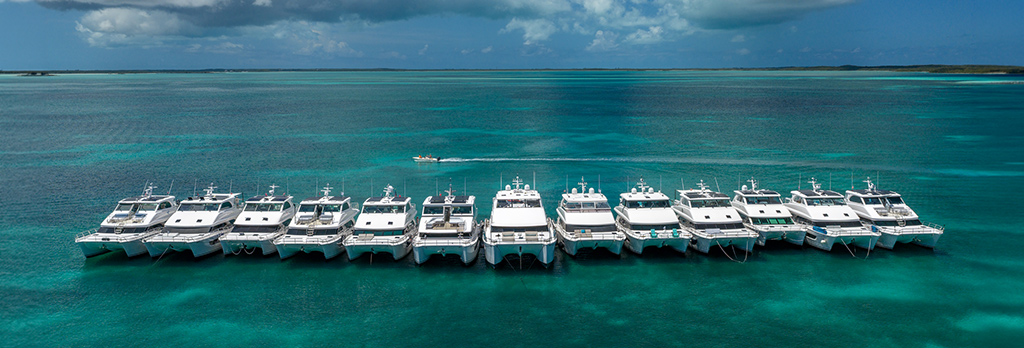
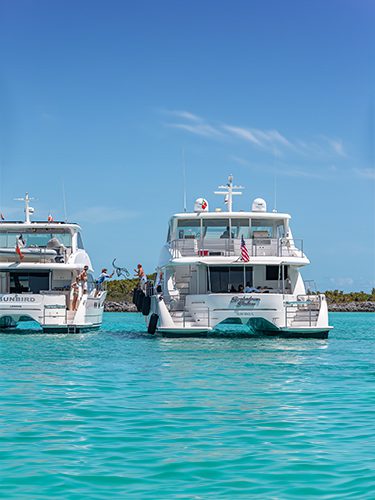
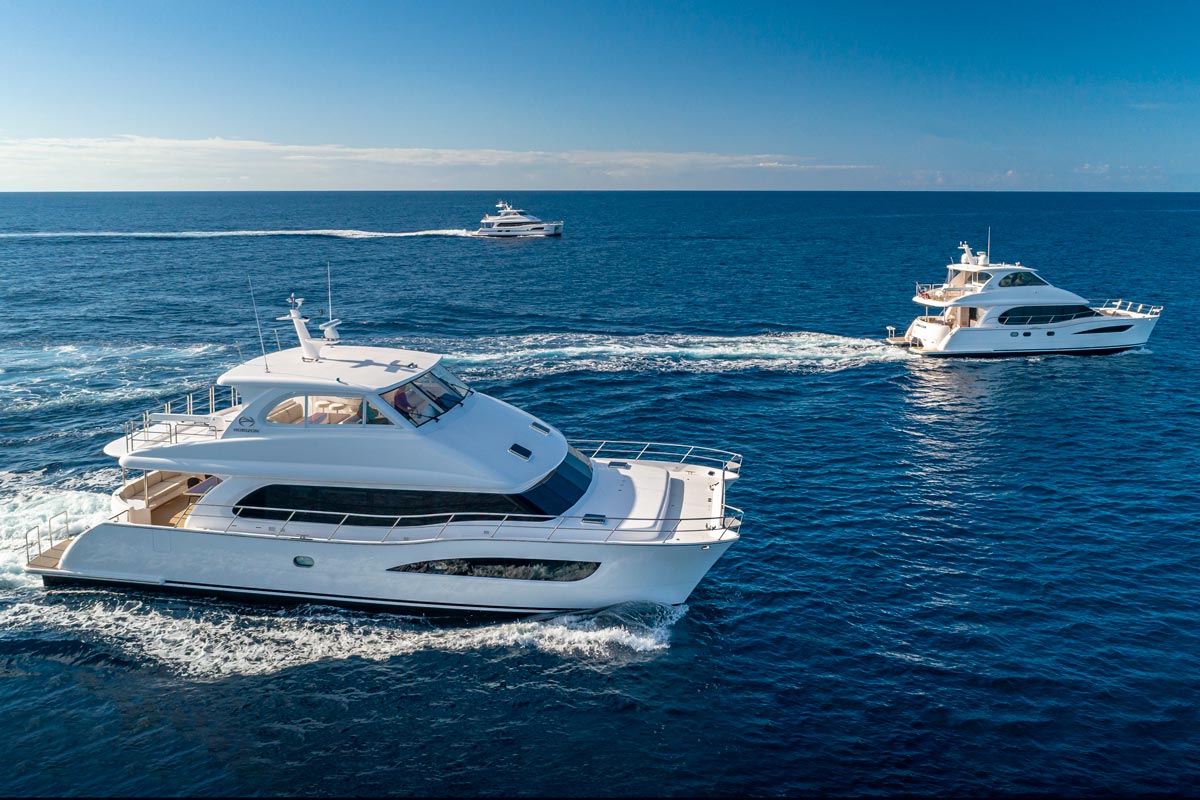
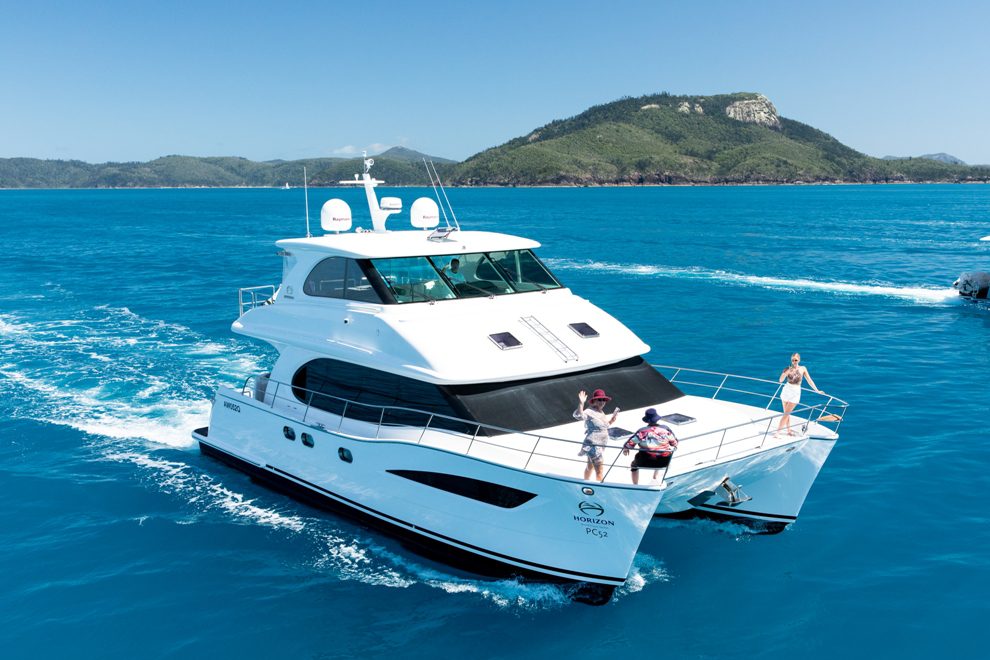
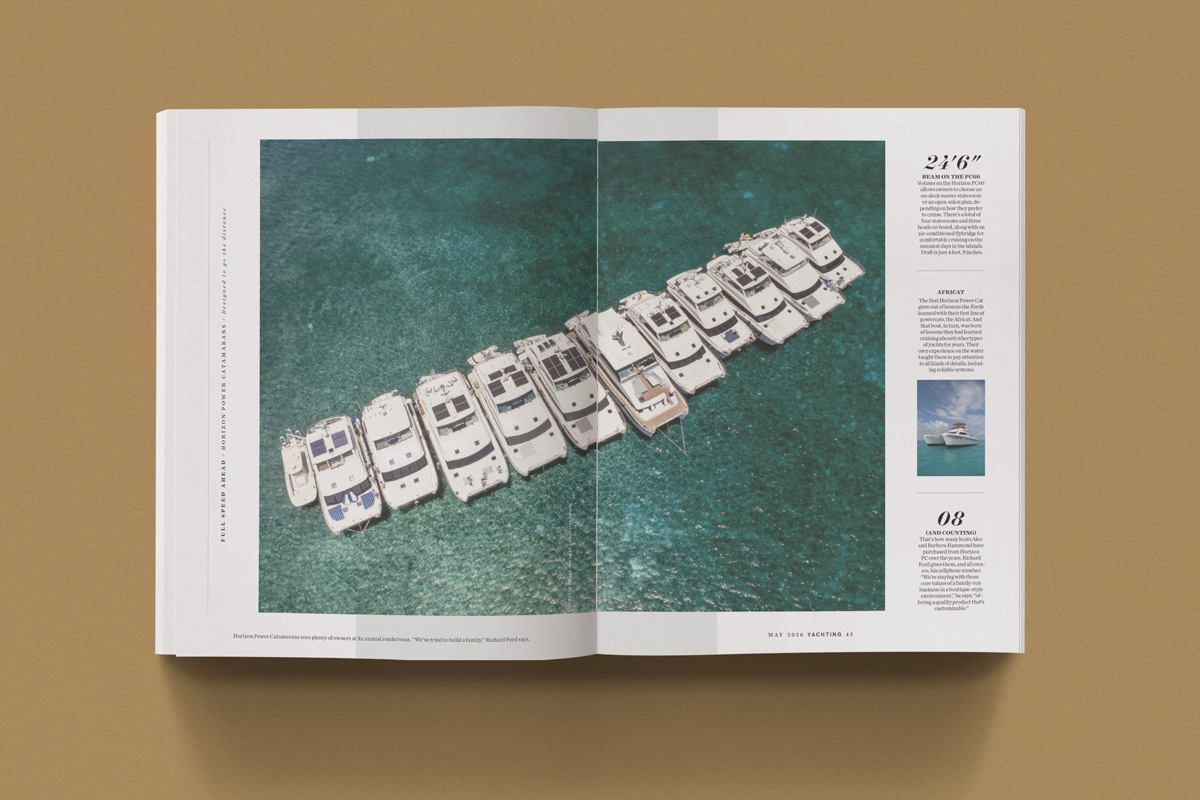
The PC60 made its debut at the 2011 Fort Lauderdale International Boat Show, and it spawned a line of power catamarans that now ranges from 52 to 74 feet length overall. “The 60 then developed into the next boat we did. It was a 52, because there was a demand for a smaller one,” Richard says. “Then we did a 65, which is now evolved to the 68. We built a one-off 74 for a customer, and since then, we’ve sold and built 66 new yachts.”
Hulls No. 67 and 68 are on track to arrive in the United States this spring, Richard says. Leigh worked with the owners, as she does with all owners, on the interiors. “Although the product style hasn’t changed much over the years, the interiors and the way that we build the boats is always evolving,” Leigh says. “We only build five or six boats a year. The fact that we’re not flooding the market with hull after hull also helps the resale market.”
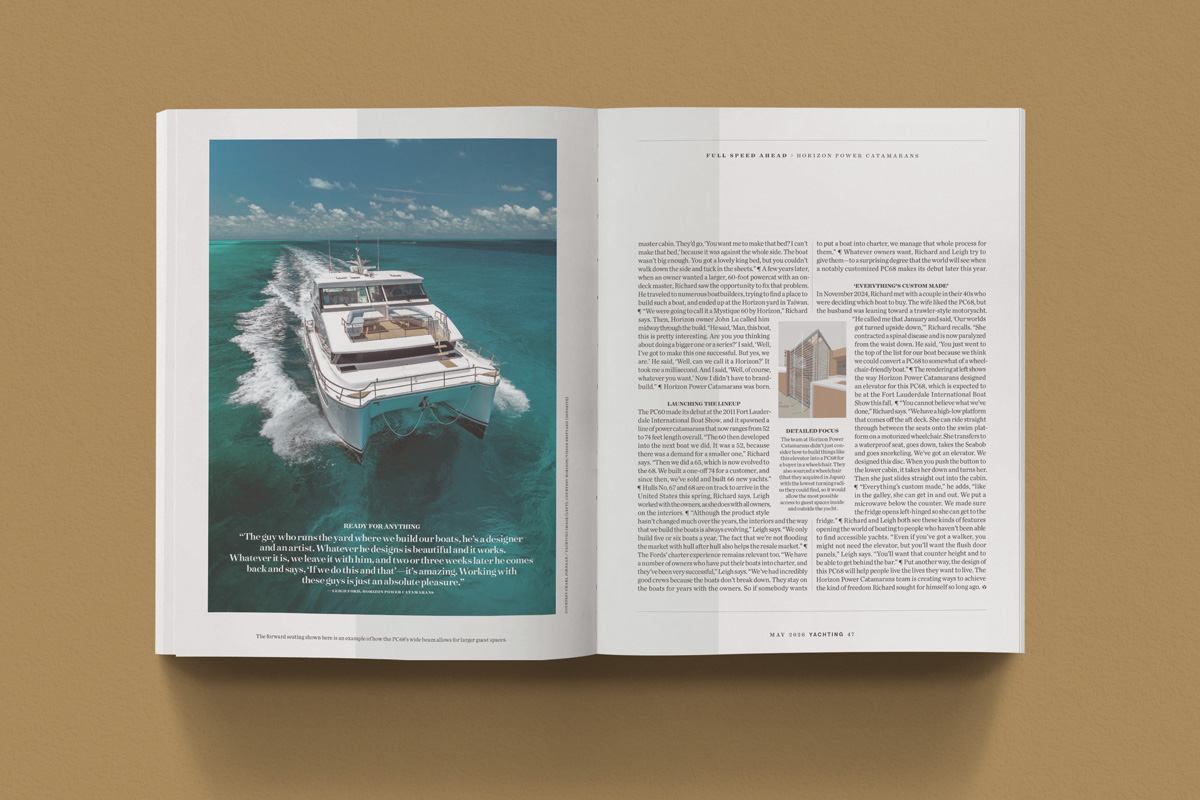
The Fords’ charter experience remains relevant too. “We have a number of owners who have put their boats into charter, and they’ve been very successful,” Leigh says. “We’ve had incredibly good crews because the boats don’t break down. They stay on the boats for years with the owners. So if somebody wants to put a boat into charter, we manage that whole process for them.” Whatever owners want, Richard and Leigh try to give them—to a surprising degree that the world will see when a notably customized PC68 makes its debut later this year.
‘EVERYTHING’S CUSTOM MADE’
In November 2024, Richard met with a couple in their 40s who were deciding which boat to buy. The wife liked the PC68, but the husband was leaning toward a trawler-style motoryacht.“He called me that January and said, ‘Our worlds got turned upside down,’” Richard recalls. “She contracted a spinal disease and is now paralyzed from the waist down. He said, ‘You just went to the top of the list for our boat because we think we could convert a PC68 to somewhat of a wheel-chair-friendly boat.”
The rendering in the image above shows the way Horizon Power Catamarans designed an elevator for this PC68, which is expected to be at the Fort Lauderdale International Boat Show this fall. “You cannot believe what we’ve done,” Richard says. “We have a high-low platform that comes off the aft deck. She can ride straight through between the seats onto the swim platform on a motorized wheelchair. She transfers to a waterproof seat, goes down, takes the Seabob and goes snorkeling. We’ve got an elevator. We designed this disc. When you push the button to the lower cabin, it takes her down and turns her. Then she just slides straight out into the cabin.
“Everything’s custom made,” he adds, “like in the galley, she can get in and out. We put a microwave below the counter. We made sure the fridge opens left-hinged so she can get to the fridge.” Richard and Leigh both see these kinds of features opening the world of boating to people who haven’t been able to find accessible yachts. “Even if you’ve got a walker, you might not need the elevator, but you’ll want the flush door panels,” Leigh says. “You’ll want that counter height and to be able to get behind the bar.”
Put another way, the design of this PC68 will help people live the lives they want to live. The Horizon Power Catamarans team is creating ways to achieve the kind of freedom Richard sought for himself so long ago.
To read the full issue or subscribe to Yachting Magazine, click here.